
Facebook Ads for Beginners:
How to Run Your First Campaign
A few months back, a client messaged me at almost midnight, pretty frustrated. She'd spent close to ₹3,000 on Facebook ads over two days for her home bakery, got four likes and zero orders, and was ready to write off ads entirely. "It just doesn't work for small businesses," she said.
It wasn't the platform. It was the setup. No clear goal, targeting that was way too broad, and an ad creative that looked like it was trying to sell to literally everyone in Kerala at once. Once we fixed those three things — just those three — the same budget started bringing in actual orders within a week.
I bring this up because if you've been avoiding running your first ad because Ads Manager looks like the cockpit of a plane, you're not wrong that it's confusing. But most of what trips people up isn't complicated once someone actually shows you where to look. So that's what this is — Facebook ads for beginners, written the way I wish someone had explained it to me the first time.
Quick thing first: Facebook ads or Meta ads?
Same thing. Meta renamed the company a while back, so technically you're using Meta Ads Manager now. But the ads still run on Facebook, Instagram, and Messenger, and honestly most people — myself included, most days — just keep calling them Facebook ads out of habit. You'll see both terms in this post. Don't overthink it.
What they actually are: paid posts that show up in someone's feed based on who you tell Meta you want to reach. Age, location, interests, whether they've visited your website before. That targeting is the whole point, really. It's the difference between a billboard that everyone driving past ignores, and an ad that only shows up for people who might genuinely care.
Why bother, if you're a small business?
Because you can start small. That's the honest answer. You don't need a huge budget to test whether this works for you — you can run something for a week, see what happens, and adjust before you've spent anything close to what a print ad or a local radio spot would cost.
The catch is that "starting small" only works if you actually set things up properly first. Otherwise you're just doing what my bakery client did — burning through a budget without giving yourself a fair test.
Okay, let's actually set one up
Here's roughly how I'd walk a client through their first campaign, step by step.
Get your Meta Business Suite sorted first
This is different from your personal Facebook login — it's the business hub everything runs through. If you already have a Page, this takes maybe ten minutes. Annoying ten minutes, but ten minutes.
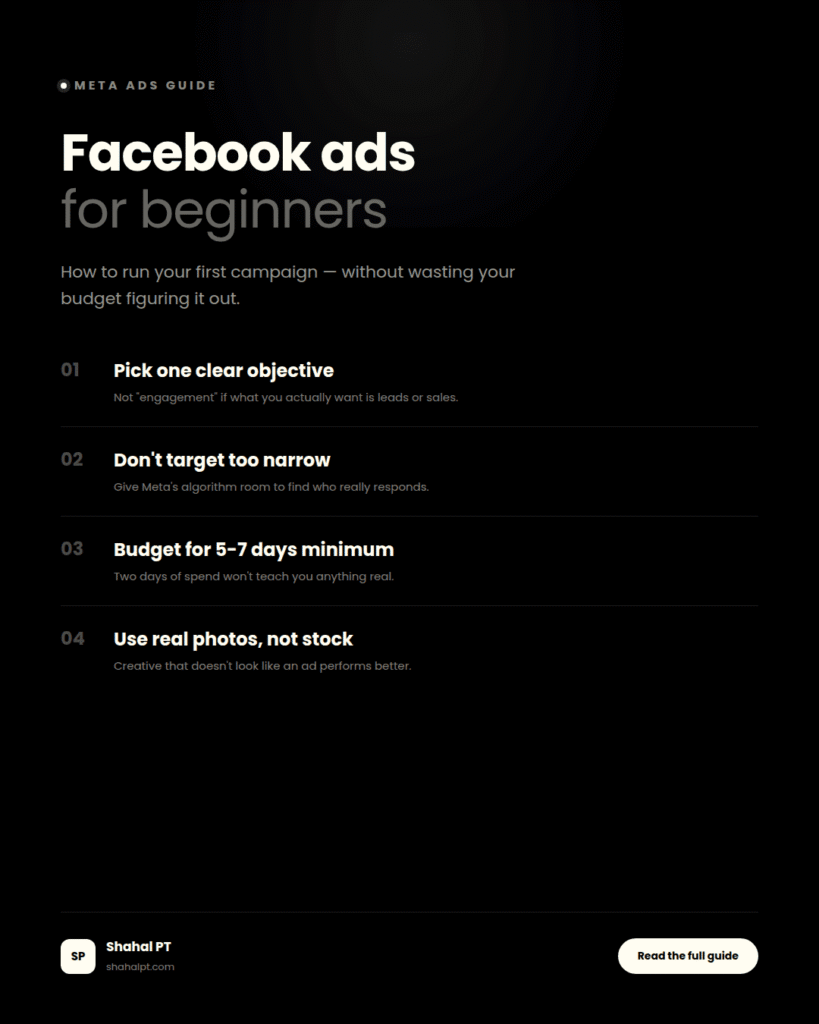
Pick one objective and be honest about it
Meta gives you a list — awareness, traffic, engagement, leads, sales, messages. A lot of first-timers pick "engagement" because it sounds safe, when what they actually want is people calling or messaging them. If that's you, pick the objective built around that, not likes. The objective you choose changes who Meta shows your ad to, so this matters more than almost any other setting.
Think about your audience before you touch the targeting screen
This is where I've seen the most money wasted, genuinely. People open the targeting options and start clicking interests before they've even asked themselves who actually buys what they're selling. Sit with that question for five minutes before opening Ads Manager at all.
And when you do get to targeting — resist narrowing it down too much. I get why it feels smart to target "women, 25-34, interested in organic skincare, living within 5km." But Meta's algorithm needs room to find who actually responds, and an audience that tiny often means your campaign never leaves what's called the learning phase. Start a bit broader than feels comfortable.
Give it a budget that can actually teach you something
₹200 a day for two days won't tell you anything meaningful — that's basically what happened to my bakery client. I usually tell people: pick a modest daily budget you're comfortable with, but commit to at least five to seven days before judging it. The algorithm needs that runway.
Make creative that doesn't look like an ad
This is the part people underestimate most, and it's honestly where the biggest wins are. Real photos beat stock images almost every time. A phone video of your actual product or actual workspace tends to outperform a polished graphic. Write the copy the way you'd text a friend about it, not the way a brochure talks. And whatever you promise in the ad, make sure the page someone lands on actually delivers that — mismatched expectations kill conversions fast.
Then leave it alone for a bit
I know this is the hardest part.in meta ads Once it's live, don't touch it every hour refreshing the numbers. Meta needs a short window to learn who's responding, and editing the campaign constantly during that window basically resets the clock. Give it a few days. Then look at the actual numbers, not your gut feeling.
Facebook or Instagram — do you have to pick?
Not really, and this is one of the genuinely nice things about the platform. When you set up placements, you can let Meta run the ad across both Facebook and Instagram automatically, and it'll shift spend toward whichever performs better for you.
If what you're selling is very visual — food, fashion, design, anything that photographs well — Instagram often pulls slightly harder.in meta ads If you're going after an older or more local, community-based crowd, Facebook still holds its own. For a first campaign, I'd just let it run across both and check the placement breakdown afterward rather than guessing upfront.
So... how much does this actually cost?
I wish I had a clean number for you. I don't, and anyone who gives you one without knowing your industry, your audience, and your competition is guessing. It genuinely varies — by niche, by season, by how good your ad actually is.
What I can tell you: Facebook ads stay accessible for small businesses in a way a lot of other advertising doesn't. You can meaningfully test this with a modest monthly budget. Just don't obsess over cost-per-click as your only measure of success. Look at cost per actual result — per lead, per message, per sale. A more expensive click that turns into a customer is worth infinitely more than a cheap one that goes nowhere.
Mistakes I keep seeing, over and over
Turning a campaign off after two days because it "isn't working" — before the algorithm's even had a chance to learn.
Targeting so narrow the campaign never really gets going.
Sending clicks to a slow website, or worse, a website that doesn't match what the ad promised.
Running the exact same ad creative for a month straight and wondering why performance is dropping.
Deciding what's "working" based on a feeling instead of actually opening the results tab.
A few quick questions people usually ask me
Do I need a website to run Facebook ads?
Not strictly — you can run ads that just send people to a WhatsApp chat or a Messenger conversation, which honestly works well for a lot of local businesses that don't have a site yet. But if you do have one, make sure it loads fast on a phone. Half your traffic is coming from a mobile screen on patchy data, not a laptop on wifi.
How long before I see real results?
Give any new Facebook ads campaign at least a week before drawing conclusions. I know that's not the answer people want to hear when they're checking Ads Manager every twenty minutes, but the first few days are genuinely just the algorithm figuring things out. Judging it on day two is like judging a movie from the trailer.
Can I just boost a regular Facebook post instead of using Ads Manager properly?
You can, and it's tempting because the button's right there under your post. But boosted posts have way fewer targeting and objective options than a proper campaign built in Ads Manager. Fine for quick visibility, not great if you actually want leads or sales.
Where to go from here
Your first campaign won't be perfect. Nobody's is. What actually matters is setting it up with a real goal, giving it enough time and budget to learn something, and then paying attention to what it tells you instead of guessing.
Want a second pair of eyes on your setup?
I help brands build out their first campaign properly — targeting, creative, and tracking what's actually working — before they spend a single rupee on it.
Let's talk on WhatsApp